Whiny Babies

When I read this piece on Truthdig by Alexander Reed Kelly, which referred to an article in the November Harper’s Magazine by economist Jeff Madrick saying that entitlements aren’t the problem causing our deficits, too-low tax rates are the problem, it reminded me of something I wrote a couple of years ago:

Yesterday President Obama and the Republicans worked out a deal on extending the Bush tax cuts from 2001. They also threw in a “temporary” reduction in the payroll tax we pay for social security, dropping it by two percentage points. So now we’ll pay even less in taxes, without giving up anything. We’ve come to believe we shouldn’t have to. It’s really a pretty sweet deal – we just keep shoving this massive debt off on you. You’ll be paying on this long after we’re dead, buried, and cursed by you a dozen times over. There’s a fair chance that the United States you’ll know will be crippled by this debt, but hey, we don’t like paying taxes, and we punish anyone who says we should. Oh sure, some of our politicians talked about cutting the deficit in our time, but that was just posturing to get elected. So we’ll keep spending, and cutting taxes because we come up with these nice theories that say cutting taxes will somehow increase the amount of money the government takes in, and we keep on spending like we have even more money coming in. It’s really been a bizarre thirty years, if you stop and think about it, as we’ve piled up deficit after deficit. There was this president named Bill Clinton who actually did do something about the deficit – he even left office with a budget surplus – but the next president, George Bush, took care of that in short order. Tax cuts, you know. Have to cut taxes, give money back to the people. It sounds noble, except that – you guessed it – he kept spending like there weren’t any tax cuts. So, the debt got higher and higher. Anyway, I digress. We, as I said, have another deal on the way, cutting taxes more, sending you more debt, all nicely wrapped up with a pretty bow. Yeah, I know, you’d have preferred to have been able to spend your tax money on repairing roads and bridges, and building new schools, and keeping the military in tip-top shape. Heck, you might have even wished you could have had some tax cuts for yourself. That last will be hard for you to do, I suspect. Just the interest on what we’ve piled up will probably strain what you can afford in taxes. But, you know, tough. We like all this stuff we have. We just don’t like paying for it. That’s what you’re for. And, like I said, we’ll be dead. We won’t care, any more than we do now.

Sincerely,

We The People

In the two years since I wrote that, the deficit has stayed absurdly high, social security has gotten less secure (due to the reduced revenue from the 2% payroll tax cut), and President Obama’s willingness to attempt to compromise with the Republicans has gotten him exactly zero credit with the populace. The payroll tax cut is the one thing Obama has done that really disappointed me. And the problem with a “temporary” tax cut is that there’s no such thing in our political environment. The Republicans will always paint the end of a tax cut as a tax increase. It’s as if you let employees leave early one day, then the next when they have to stay until the regular leaving time, they start screaming about lengthening the workday. Paul Ryan’s plan is for a 10% base tax rate, but the problem is no American wants to live with a 10% tax rate budget. We want to pay taxes like it’s 10% and get government services like it’s 20%. We have the lowest taxes in several generations, and all we do is whine about high taxes. You want low taxes and small government, move to Somalia.

Posted in Politics | Tagged , | 1 Comment

A Snapshot Of Mid-60s America

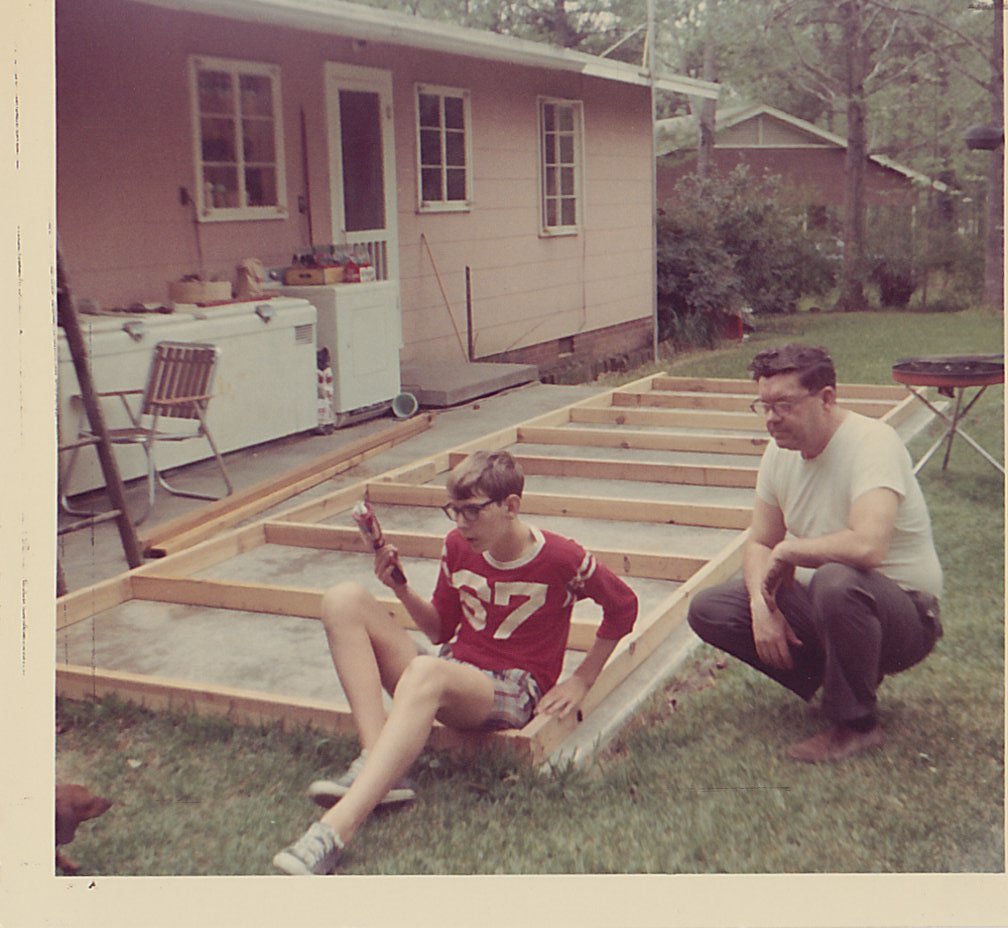
I ran across this old photo of my dad and me dating from 1966 or 1967. We were building the screen porch off the back of our house, one of my favorite places once it was done, and where I learned to love that weird light that came through those green fiberglass panels that were so prevalent then. I was 12 or 13 at the time, and I don’t remember how much of the work I did, although I do remember helping to put up the walls. But as I looked at the photo, I realized it captured life in the mid-60s in several ways. It starts with the screen door. Every house I knew of had screen doors, because the one thing they didn’t have was air conditioning. I don’t remember ever being miserably hot, and in fact I have great memories of laying in bed while the attic fan pulled in the night air through open windows. But this was Mississippi, and it was hot and humid in June, July, and August (and May and September, truth be known), so I guess it was a case of not knowing how much better it could have been. To the right of the screen door, in fact to the right of the windows, is a pole anchored to the house. This was our external television antenna, because another thing we didn’t have was cable TV. We wouldn’t get that for another 10 years. At that time, we got two channels – NBC (channel 3) and CBS (channel 12). The NBC station, I think, also carried some ABC programming, which is why, I think, we didn’t get Startrek when it originally aired. On rare occasions, we would be able to pull in channel 10, from somewhere in Arkansas, but the picture was never good. A little more subtle is the dryer, right outside the kitchen door. There wasn’t such a thing as a laundry room in any house I knew about – the washing machine was in the kitchen, and there wasn’t any room for a dryer, so when we got one it went outside. But not for long, because the screen porch, which covered the entire patio, came along shortly after the dryer. And the pink color of the house is another indication – I don’t recall seeing pink houses after about 1970. But it was a great house to grow up in, even though there were seven of us crammed into that 950 or so square feet (and one bathroom). Oh, and last but not least – dig those low-top Converse tennis shoes!

Posted in Life, Mississippi | 6 Comments

99 Life Hacks

These are just too good to not share:

99 Life Hacks to make your life easier

H/t to Brian

Posted in Life | Tagged | Leave a comment

It’s All About The Asters

While I always pick up a few chrysanthemums from garden centers this time of year, the stars of my garden are the asters and Clara Curtis chrysanthemum (although I’ve read that Clara has been reclassified as a dendrathemum). The asters have spread to where I have small masses scattered through my beds:

asters

and more:

asters

and along the fence in front:

asters

I’ve pretty much let them have the run of this bed:

asters

And the Clara Curtis is blooming:

Clara Curtis chrysanthemum

A few blooms on the Blackie sweet potato vine:

And the euphorbia “Diamond Frost” has continued to bloom since late May:

euphorbia /></a></p>
<p>As soon as the asters have finished, I’m going to rework the beds on front of the fence, and maybe expand them just a bit.  The depth (only about 18″) makes it hard to stuff some of the things in there that I want to plant.  At least, that’s my plan.</p>
							</div><!-- .entry-content -->
	
			<div class= Posted in Gardening | Tagged | Leave a comment

Watching Traffic

I graduated from a small liberal arts college. I’ll get back to that.

This morning on the way to work, as I merged onto the Natchez Trace Parkway for the short segment that emptied onto the interstate, I began to look at the traffic (not for the first time) not as cars but as packets of information, flowing (or not flowing) on a network. Getting on the Trace wasn’t such a big deal; most of the traffic was merging, with just a few cars upstream. So except for the occasional ornery upstream driver who wouldn’t slow down and let you merge, things proceeded apace, which on this stretch of the Trace is 40 mph. A mile or so down the road, it gets more interesting, as you get off the Trace (which everyone has to do at the moment, because the Trace is closed at that point) and merge onto the interstate. You come into a lane on the far right, which will end in about 300 feet. You move to the left one lane, but that lane, in about 1000 feet, will veer to the right onto the bypass. So you have to move at least one more lane to the left to continue south. And if you’re smart, you won’t stay in that lane either, because another 1000 feet or so beings you to an interchange, with traffic leaving the interstate and more coming on. So it’s another move to the left, or maybe two, which would put you in the far left lane. This, you would think, would be the best lane if you’re going several miles down the road. Unfortunately, that’s most often incorrect. The middle lane of the three going south seems to often move faster, which flies in the face of reason – but Mississippi drivers don’t use reason when driving. Lane-changers are constantly moving from the center lane to the far left lane, which means drivers in the far left lane are then constantly having to slow down, because of course when you change lanes you have to then slow down just a little. This results in the center lane often having big gaps where you can maintain a decent speed, and the far left lane sometimes coming to a near-standstill. There is still a benefit in being in the far left lane – idiots changing lanes without looking can only come at you from one side (the right), and you have a small margin of safety if/when they do. But I digress – this is about traffic flow. Or really, about how I see networks everywhere. I was watching cars merge, and change lanes, and thinking about how networks behave when they get crowded, and how they don’t have packets randomly changing lanes – at least, hopefully they don’t. All highway engineers can do is design roads and interchanges, and then hope for the best. Networks can be designed, and then actively managed. We’d probably all get to work faster if the engineers could actively manage traffic.

Anyway, I said I went to a small liberal arts college, where I studied math and physics. One of my math professors considered teaching a class in queueing theory one semester. None of us, the small number of math majors, were really interested – we couldn’t see any reason why we would want such a theoretical class – so he dropped the idea. I wish he hadn’t, and I wish we’d been interested in taking the class. I sometimes think the world might make more sense to me now. Or at least, I might understand what passes for the underlying logic of things moving around me. Once again we find that youth is wasted on the young.

Posted in Life, Philosophy | Tagged , | Leave a comment